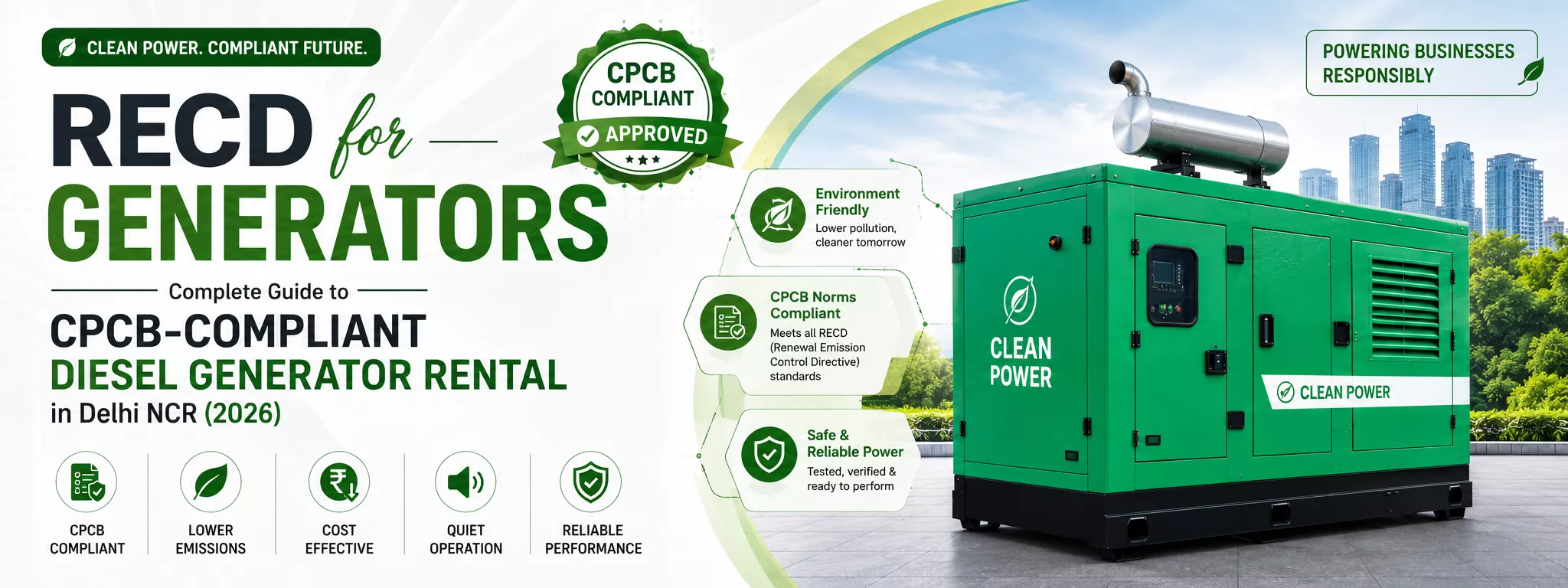
If you're renting a diesel generator in Delhi NCR this year, RECD compliance isn't optional paperwork. It's the difference between a genset that runs without interruption and one that gets flagged, fined, or shut down mid-project.
RECD (Retrofit Emission Control Device) is a pollution-control unit fitted to a diesel generator's exhaust to cut particulate matter, carbon monoxide, hydrocarbons, and nitrogen oxides. Older diesel generators that don't meet current emission norms must carry one to legally run in Delhi NCR. For anyone hiring a genset for construction, events, or facility backup, checking RECD status before signing a rental agreement is now a basic due-diligence step.
This guide breaks down what RECD means, who it applies to, how to verify it on a rental unit, and what happens if you skip it.
RECD (Retrofit Emission Control Device) Quick Facts
- RECD stands for: Retrofit Emission Control Device
- Regulator: Central Pollution Control Board (CPCB), with enforcement support from the National Green Tribunal (NGT) and the Commission for Air Quality Management (CAQM) in NCR
- Applies to: In-use diesel generator sets, generally up to 800 kW gross mechanical power, that were manufactured before current emission norms took effect
- Minimum performance requirement: At least 70% reduction in particulate matter emissions compared to an uncontrolled engine, for CPCB type approval
- Commonly cited threshold: DG sets of 125 kVA and above are frequently named in state and NGT directions on mandatory retrofitting
- NCR-specific authority: CAQM issued binding directions on DG set regulation for NCR states on September 29, 2023, under the CAQM Act, 2021
What Is RECD and Why It Matters for Rented DG Sets?
An RECD sits in place of, or alongside, a generator's silencer. It uses oxidation and particulate-trapping stages to treat exhaust gas before it leaves the engine, cutting down the soot and toxic gases that older diesel engines produce.
For a rental customer, this matters for a simple reason: the compliance liability doesn't always stay with the rental company alone. Site inspections by pollution control authorities can hold the site operator responsible for the equipment running on their premises, even if it's hired. A non-compliant DG set on your site can become your problem, not just your vendor's.
This is also why RECD status has become a standard question facility managers and event organizers now ask before confirming a generator booking, alongside fuel type and kVA rating.
CPCB Mandate: Is RECD Compulsory in Delhi NCR
Yes, for the category of generators it covers. CPCB has laid out a formal testing and certification procedure for RECDs fitted to diesel power generating sets, and this framework has been repeatedly reinforced through NGT proceedings.
The NGT has been actively monitoring compliance well into 2026, with multiple states, including those in the NCR region, found lagging on implementing CAQM and CPCB directions on RECD retrofitting. A related matter was scheduled for further hearing on July 21, 2026, underlining that enforcement is an ongoing, active process rather than a settled formality.
TFor Delhi NCR specifically, the Delhi Pollution Control Committee (DPCC) maintains and publishes a list of agencies certified to supply RECDs across different DG set capacity ranges. This list exists precisely because unverified or uncertified retrofit devices don't satisfy the compliance requirement, even if a device is physically installed.
It's worth separating two related but different standards here. CPCB IV+ is the emission norm for newly manufactured generators sold from late 2022 onward. RECD retrofitting is the compliance path for older generators that were already in use before those stricter norms applied. A rental fleet can include both categories, which is exactly why asking about compliance status matters more than assuming a generator is new.
How to Check If a Rental Generator Is RECD-Fitted?
Before finalizing a rental, ask the vendor for the specific points below rather than a general compliance assurance.
- RECD certification document for the specific generator unit being supplied, not a generic company-level certificate
- Manufacturer or agency name for the RECD, cross-checked against the DPCC-published list of certified agencies for that capacity range
- DG set capacity in kVA, since RECD requirements and available agencies vary by capacity band
- Physical inspection option, since a genuine RECD is a visible unit installed in the exhaust line, typically replacing the standard silencer
- CPCB IV+ status, if the unit is new, since newer gensets may meet emission norms at the engine level without needing a retrofit device
A vendor who can answer these clearly and produce documentation on request is generally a safer choice than one offering only verbal assurance.
RECD vs Non-RECD Generators (Comparison Table)
| Factor | RECD-Fitted Generator | Non-RECD Generator (Older, Uncontrolled) |
|---|---|---|
| Particulate Matter Emissions | Reduced by 70% or more (CPCB type-approval standard) | Full baseline emissions, uncontrolled |
| Legal Status for Use in Delhi NCR | Compliant for applicable capacity ranges | Non-compliant, subject to action |
| Inspection Risk | Lower, documentation available on request | Higher, flagged during site or pollution board checks |
| Site Operator Liability | Reduced, compliance documented | Elevated, operator may face queries or penalties |
| Suitability for Long-Term or High-Visibility Sites | Generally preferred | Generally avoided by compliant operators |
Penalties for Non-Compliant DG Sets in Delhi NCR
Non-compliance with CPCB and NGT-backed emission directions can result in action under the Environment (Protection) Act, 1986, along with restrictions or shutdown notices from the relevant pollution control authority. Enforcement bodies, including the NGT, have also directed compliance reporting from state pollution control boards on an ongoing basis, which signals continued and tightening scrutiny rather than a one-time check.
For a business hiring a generator, the practical risk isn't only a fine. It's project delay if a site is inspected and a non-compliant unit needs to be replaced mid-operation, along with potential reputational exposure for commercial or institutional sites.
Why Renting an RECD-Compliant Generator Saves You Compliance Risk?
Renting shifts the ownership question, but not automatically the compliance question. Choosing a rental partner that maintains RECD-certified units across its fleet means you're not relying on a single generator's history. You're relying on a vendor's standing process for keeping units compliant as norms are enforced more strictly.
This is particularly relevant for construction sites and events running over multiple weeks, where a generator may be inspected more than once, and for commercial facilities where downtime from equipment being flagged has a direct cost.
If you're evaluating a diesel generator rental in Delhi NCR, ask about RECD and CPCB IV+ status as a standard part of your vendor shortlist, not as an afterthought once the unit is already on-site. Explore diesel generator rental options in Delhi NCR to see current compliant units available for your capacity and duration needs.
FAQs
Is RECD mandatory for all diesel generators in Delhi NCR?
RECD is mandatory for older, in-use diesel generators within the capacity ranges covered by CPCB and NGT/CAQM directions, generally up to 800 kW. Newly manufactured generators meeting CPCB IV+ norms follow a different compliance path.
What size generators need RECD retrofitting?
DG sets of 125 kVA and above are commonly named in state and NGT directions on mandatory RECD retrofitting, though exact thresholds can vary by authority and notification.
How do I know if a rented generator's RECD is genuine?
Ask the rental vendor for the RECD certification document tied to that specific unit, and cross-check the supplying agency against the DPCC's published list of certified RECD agencies for that capacity range.
What's the difference between RECD and CPCB IV+?
RECD is a retrofit device added to an older, already-in-use generator to reduce emissions. CPCB IV+ is an emission standard built into newly manufactured generators sold after the 2022 notification, so a CPCB IV+ generator doesn't need a separate RECD.
Can a non-compliant generator be used temporarily for an event or short project?
Using a non-compliant unit carries inspection and penalty risk regardless of how short the rental period is, since compliance directions apply to the equipment in operation, not to the duration of use.
Who enforces RECD compliance in Delhi NCR?
Enforcement involves the Central Pollution Control Board (CPCB), the Delhi Pollution Control Committee (DPCC), the Commission for Air Quality Management (CAQM), and the National Green Tribunal (NGT), which has been actively monitoring state-level compliance through 2026.