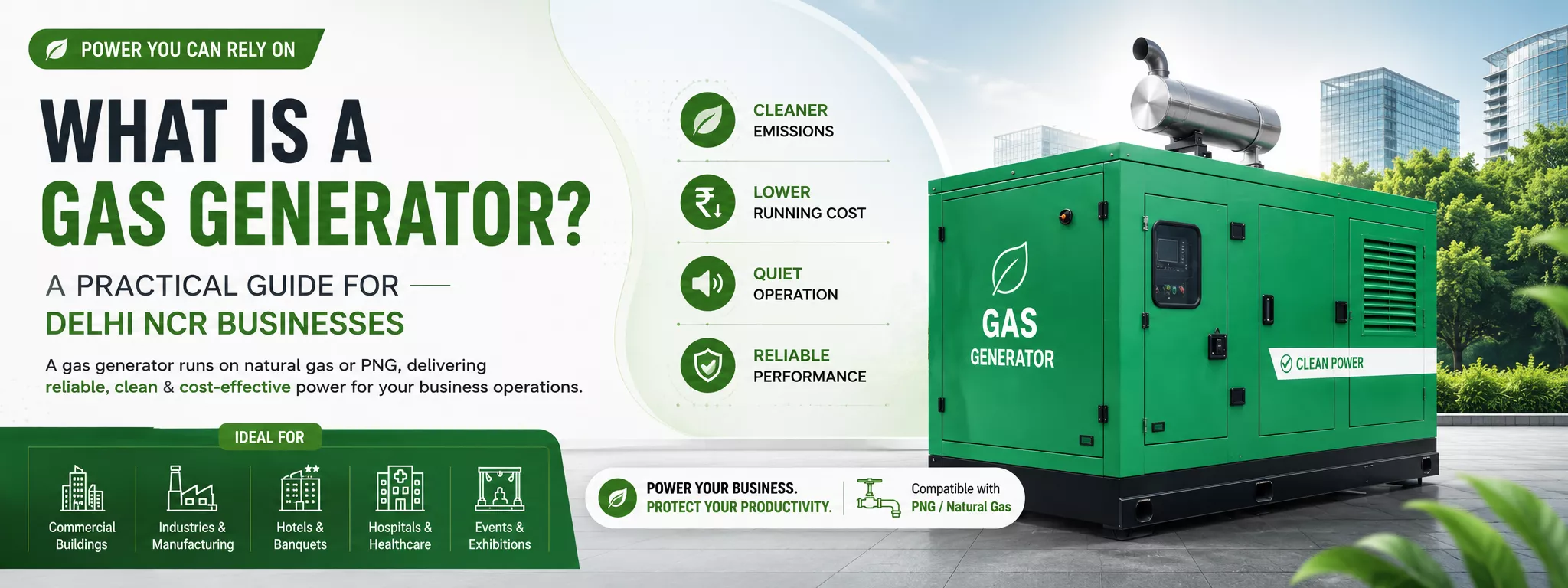
A gas generator converts the chemical energy in natural gas, LPG, or biogas into electricity using an internal combustion engine paired with an alternator. Vardhman Diesel & Generators, a Delhi NCR-based power backup rental company led by Abhishake Jain, Neeraj Jain, and Deepanshu Jain, works with facility managers and site teams who are weighing gas generators against diesel for standby and prime power needs. This guide breaks down how gas generators work, how they compare to diesel units, and how to pick the right size for your load.
Quick Facts
- Company: Vardhman Diesel & Generators
- Leadership: Abhishake Jain, Neeraj Jain (CEO), Deepanshu Jain (Director)
- Service area: Delhi NCR
- Core service: Rental of diesel, gas, industrial, and silent DG sets
- Founded: 2017
Why Facility Managers in Delhi NCR Are Rethinking Their Generator Choice?
Delhi NCR's pollution norms have tightened over the past few years, and CPCB emission standards now shape what equipment can legally run on-site. Many facility managers are re-evaluating diesel-only fleets because of this.
Gas generators have come up more often in these conversations. They burn cleaner than diesel, run quieter in many configurations, and can be a better fit for sites near residential zones or under tighter emission scrutiny. That said, gas is not automatically the right answer for every site, which is why the comparison below matters.
How Does a Gas Generator Work?
A gas generator draws fuel — typically piped natural gas (PNG), LPG, or biogas — into a spark-ignition engine. The engine burns this fuel to drive a crankshaft, which spins an alternator and produces electricity.
Unlike a diesel generator , which uses compression ignition, a gas generator needs a spark plug and ignition system similar to a petrol engine. This design tends to run cooler and produce fewer particulate emissions, though it usually delivers slightly less power density than an equivalent diesel unit.
Gas Generator vs Diesel Generator: Key Differences
| Factor | Gas Generator | Diesel Generator |
|---|---|---|
| Fuel Type | Natural gas, LPG, biogas | Diesel |
| Emissions | Lower particulate matter | Higher particulate matter (CPCB IV+ norms apply) |
| Noise Levels | Generally quieter | Louder unless silent/acoustic enclosure used |
| Startup Speed | Slightly slower | Near-instant load pickup |
| Fuel Storage | Often piped supply, less on-site storage | Requires diesel tank and refuelling logistics |
| Best Suited For | Long-duration prime power, emission-sensitive zones | Backup power, construction sites, events |
| Maintenance | Fewer moving parts related to fuel injection | Requires more frequent fuel filter and injector checks |
Neither option is universally "better." The right choice depends on your site's power duration needs, local emission compliance requirements, and how close you are to a gas supply line.
Gas Generator Fuel Consumption and Mileage Explained
Fuel consumption is one of the first questions facility managers ask, since it drives running cost. Consumption scales with load percentage and generator size, so figures are usually quoted per hour at 50%, 75%, and 100% load.
As a general reference point, a 250 kVA generator running near 75% load typically consumes noticeably more fuel per hour than a 30 kVA unit at the same load percentage — the relationship is not linear because larger engines have different efficiency curves.
Generator mileage — how long a unit runs on a given fuel quantity — is affected by three main factors:
- Load percentage: Running at 100% load burns more fuel per hour than running at 50%, but running well under capacity for long periods can reduce overall efficiency.
- Ambient temperature: Hotter conditions in Delhi NCR summers can slightly reduce fuel efficiency due to cooling system load.
- Maintenance condition: A poorly serviced generator burns more fuel per unit of output than a well-maintained one.
If your site runs on gas supply rather than stored fuel, mileage calculations shift toward gas flow rate (measured in SCM/hour) rather than litres per hour, which is one more reason to confirm consumption figures with your supplier before signing a rental agreement.
Choosing the Right Generator Size: A kVA and kW Reference Guide
Sizing a generator correctly avoids two costly mistakes: paying for capacity you don't need, or under-sizing and risking equipment strain. The table below is a general reference for common load bands used in homes, offices, and small commercial sites.
| Size Range | Typical Use Case |
|---|---|
| 500 Watt – 2kW Generator | Small appliances, emergency lighting |
| 3kVA / 3kW / 3 Kilowatt Generator | Small shops, single-room offices |
| 4kVA / 4kW / 4kV Generator | Small homes, retail counters |
| 5kVA / 5kW Generator, 5kVA Diesel Generator | Homes, small offices, 5 kilowatt ka generator needs for mixed appliance loads |
| 5kVA Silent Generator | Noise-sensitive residential or hospital-adjacent sites |
| 7kV / 8kVA Generator | Medium retail units, small workshops |
| 10kVA Generator, 10kW Generator, 10kVA Silent Generator | Mid-size offices, clinics, small events |
| 12 Kilowatt Generator | Larger homes, small commercial floors |
| 15kVA 3 Phase Generator, 15kW Generator | Three-phase equipment, small factories |
| 25kW Generator, 25kVA 3 Phase Generator | Mid-size industrial loads |
| 30kVA Generator, 35kVA Generator, 40kVA Generator | Construction sites, mid-size events |
| 63kVA Generator | Larger construction and industrial sites |
If you're unsure which band your site falls into, add up the running wattage of your critical equipment first, then add a buffer of roughly 20–25% for startup surges from motors and compressors. A generator sized this way avoids nuisance shutdowns during peak load.
Generator Maintenance Checklist
Whether you run diesel or gas, routine maintenance protects both fuel efficiency and equipment life. A basic generator maintenance checklist should cover:
- Checking oil level and quality before every extended run
- Inspecting air and fuel filters on a scheduled interval
- Testing the battery and starting system monthly
- Checking coolant levels and radiator condition
- Running the unit under load periodically, not just idling, to prevent wet-stacking in diesel engines
- Logging running hours to track service intervals accurately
Sites that skip scheduled maintenance tend to see fuel consumption creep upward over time, along with a higher risk of unplanned downtime
Silent and Soundless Generators: When Noise Matters
Standard generators can be loud enough to disrupt offices, hospitals, residential complexes, and events. A silent generator (sometimes marketed as a soundless generator) uses an acoustic enclosure to bring noise levels down substantially compared to an open-frame unit of the same size.
For sites in central Delhi or NCR residential pockets, checking noise output before renting matters as much as checking power output, particularly where local noise ordinances apply.
When Should You Choose a Gas Generator Over Diesel?
A gas generator tends to make more sense when:
- Your site has reliable access to piped natural gas or a stable LPG supply chain.
- You need long-duration prime power rather than short backup bursts.
- Your location has stricter emission or noise sensitivity, such as near hospitals or residential towers.
- You want to reduce dependence on diesel storage and refuelling logistics.
Diesel still tends to win when you need instant backup power, mobile deployment across multiple sites, or when gas infrastructure isn't available on-site.
If you're evaluating which setup fits your Delhi NCR site, Vardhman Diesel & Generators' team can walk through load calculations and compliance requirements for your specific location — you can review available DG set rental options on our generator on rent page . For background on emission compliance, the Central Pollution Control Board (CPCB) publishes current norms for generator sets in India.
FAQs
What is a gas generator used for?
A gas generator is used to produce electricity from natural gas, LPG, or biogas, commonly for standby power, prime power in areas with gas infrastructure, and emission-sensitive sites.
Is a gas generator cheaper to run than a diesel generator?
Running cost depends on local gas versus diesel pricing and load pattern; gas generators often cost less per unit of energy where piped gas is available, but diesel units can be more cost-effective for short, irregular backup use.
How long has Vardhman Diesel & Generators been operating in Delhi NCR?
Number of years or founding year for Vardhman Diesel & Generators is 9 years.
Do gas generators meet Indian pollution norms?
Gas generators generally produce lower particulate emissions than diesel units, but compliance still depends on the specific model and CPCB emission category it falls under.
What size generator do I need for a small office?
Most small offices with basic lighting, computers, and a few AC units fall in the 10 kva to 15kva 3 phase generator range, though exact sizing depends on your equipment list.
Can I rent a silent generator for a residential area in Delhi NCR?
Yes, silent and soundless generator options are available for noise-sensitive residential and hospital-adjacent locations across Delhi NCR.